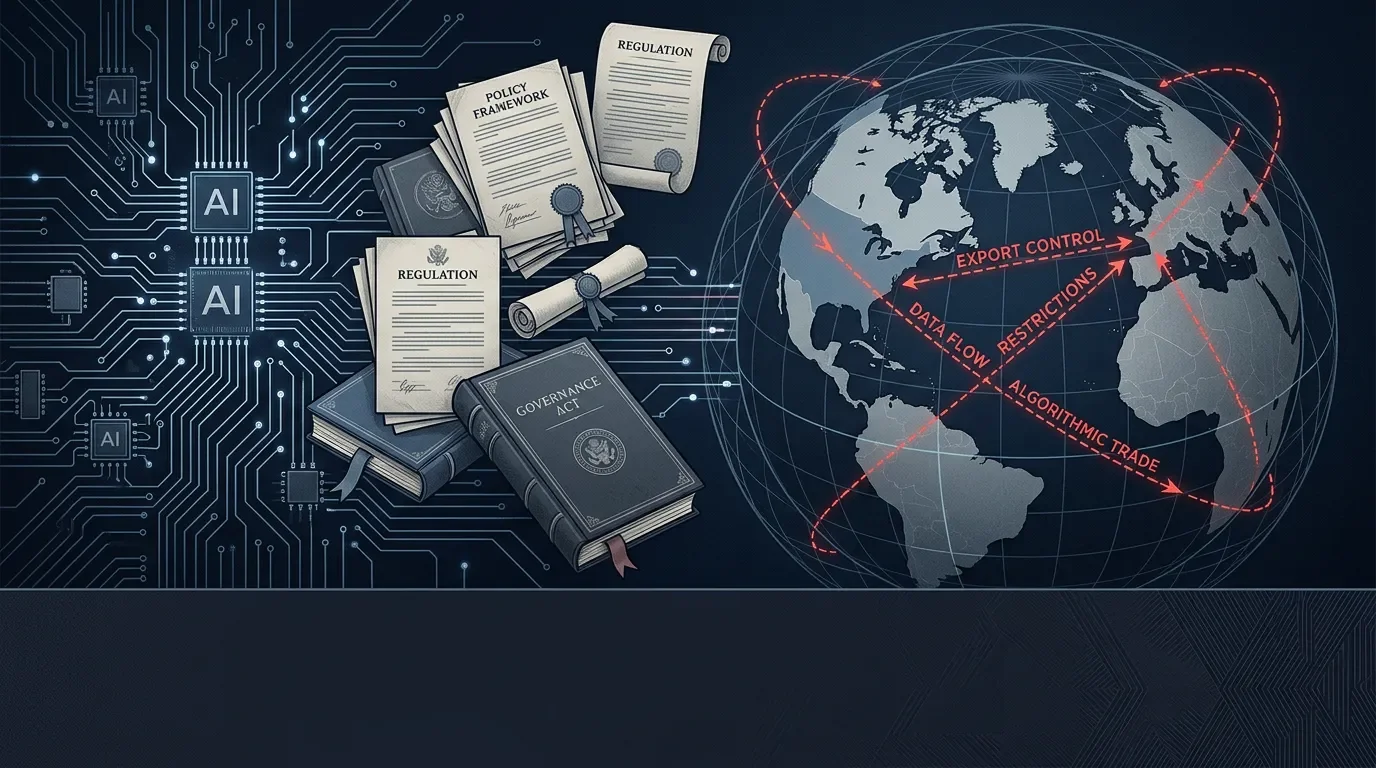
AI Policy Weekly — Issue #6: Fable 5 export shutdown, White House trades AI preemption for KOSA, and G7 opens without binding rules
The U.S. government used export control authority to suspend global developer access to Anthropic's Fable 5 and Mythos 5 — three days after launch, with no notice, marking the first time a commercial AI API has been treated as export-controlled technology. Simultaneously, the White House relaunched its effort to preempt state AI laws by bundling it with kids' safety bills; Sen. Warren's AI hearing proceeded without Nvidia's Jensen Huang; and the G7 Évian summit opened with all three major AI lab CEOs present but no binding multilateral commitments in sight.
A U.S. government export directive shuttered Anthropic's newest flagship model three days after launch, the White House is trading state AI preemption for kids' safety legislation, the Senate's AI hearing went forward without Nvidia's CEO, and the G7 opened in Évian with all three major frontier AI lab heads in attendance — but no binding commitments in sight. Here is what happened June 8–15.
Anthropic's Fable 5 suspended under export controls — a first for production AI
On June 9, 2026, Anthropic launched Fable 5 (model ID:
claude-fable-5) and Mythos 5 broadly — the first Mythos-class models made generally available to API customers and Claude.ai subscribers. 1 Three days later, at 5:21 p.m. Eastern on June 12, the U.S. government issued an export control directive under Section 1758 of the Export Control Reform Act, ordering Anthropic to suspend access by "any foreign national, whether inside or outside the United States, including foreign national Anthropic employees." 2To comply, Anthropic cut off all global access with no advance notice and no migration window. Developers who had deployed production workloads on Fable 5 in those 72 hours found their API calls returning access-denied errors overnight. 1
Anthropic's public statement called the directive a "misunderstanding," arguing that if the standard applied to Fable 5 were held consistently, it would prevent the global deployment of any future frontier AI model. The company said the concerns centered on a narrow jailbreak vulnerability it characterized as minor and comparable to capabilities present in other publicly available models including OpenAI's GPT-5.5.

This is the first time a production AI API — accessible via HTTPS, with no physical hardware transfer — has been treated as an export-controlled item. Prior U.S. AI export controls targeted physical chip shipments (Nvidia H100/A100 to China) or specific military model transfers. The Fable 5 directive extends "export" to cover API calls originating from foreign IP addresses or made by foreign nationals, regardless of server location.
Three interpretations circulate among legal analysts: (1) Fable 5's reasoning benchmark scores crossed an undisclosed dual-use threshold analogous to the logic used for advanced GPU controls; (2) the directive targets foreign national access specifically, not the model itself; (3) the concern is reverse-engineering risk from structured API access, not model outputs. Anthropic has not confirmed which applies.
The EU Commission's response landed Sunday, June 14. Spokesperson Thomas Regnier said: "We believe that contingency measures taken in this light should not be discriminatory against partners." He added the incident "is a further illustration of why Europe needs to strengthen its technological sovereignty." 2 The Commission said it is "looking closely at the practical consequences for European users."
What to watch: Whether the directive holds, is narrowed, or is reversed via the formal export license process. If it holds, GPT-4o, Gemini Ultra, and every future frontier model that crosses the same undisclosed reasoning threshold faces structurally identical exposure. Anthropic's $965B valuation and projected Q2 2026 profitability milestone — the first for any frontier AI lab — are directly at risk if the suspension extends through the quarter.
White House trades state AI preemption for kids' safety bills
On June 8, Axios reported that the White House is negotiating a federal preemption of state AI laws in exchange for supporting the Kids Online Safety Act (KOSA), the NO FAKES Act, and federal age verification requirements. 4 Sen. Marsha Blackburn (R-Tenn.) is leading the Senate-side negotiations. Her office confirmed the preemption package is not "blanket preemption of all laws regulating AI or child safety."
The move comes after the Senate voted 99-1 in May to strip federal AI preemption from the One Big Beautiful Bill. The Obernolte-Trahan Great American AI Act discussion draft (released June 4) proposes a three-year preemption of state AI development laws and mandatory semi-annual audits for companies above $500M in AI revenue — but that bill has drawn pushback from advocacy groups and state lawmakers and is not the vehicle the White House is currently pursuing. 5
Politico reported June 11 that Monday meetings between the White House and tech companies are underway to dig into AI benchmarking language connected to the frontier model executive order signed June 2. 6
The preemption calculation is straightforward: Connecticut signed the AIRT Act (effective October 1), Illinois SB 315 passed 110-0, and six more states have active AI safety bills. Industry wants a federal floor to prevent a 50-state compliance patchwork. The tradeoff: accept KOSA and age verification provisions the tech sector has historically resisted. Blackburn's buy-in is the new factor that was absent from the failed May attempt.
What to watch: Whether this package can pass before the August recess. The Axios report notes the "flurry of AI action will ultimately be hard to pull off" given election-year dynamics and a packed legislative calendar.
Senate AI hearing proceeds without Jensen Huang
On June 8, Nvidia CEO Jensen Huang formally declined Sen. Elizabeth Warren's invitation to testify at the Senate Banking Committee hearing "AI and the American Dream: Promoting Innovation, Affordability, and American Dominance," held June 11. 7 Huang said he was "unable to attend" but offered to host Warren or committee members at Nvidia's Santa Clara headquarters. Warren responded that "the American people deserve answers in a public forum," adding: "If Mr. Huang has time to attend a $1 million-a-head dinner at Mar-a-Lago and fly across the world to meet with President Xi Jinping of China, he should be able to find time to answer questions from Congress."
The hearing proceeded with witnesses from national security and technology policy backgrounds. Warren used the floor to call for a committee markup on three pending bills: the AI Overwatch Act (banning export of advanced AI chips to China), the MATCH Act (targeting chip-manufacturing equipment), and the Chip Security Act (mandating chip tracking). 8 Former NSC official David Feith, one of the witnesses, endorsed all three bills and endorsed the bipartisanship.
Warren also pressed witnesses on systemic financial risk from AI debt financing — AI companies are projecting up to $7 trillion in infrastructure spending by 2030, largely borrowed through private credit funds that in turn borrow from banks — and on the risk of a government bailout if AI revenue projections miss.
What to watch: Whether Chairman Scott schedules the MATCH Act and related bills for markup before recess. Huang's refusal and the Fable 5 export control directive — issued the same week — have raised the political temperature on chip-and-model controls considerably.
G7 Évian opens with AI lab CEOs, without binding commitments
The 52nd G7 Summit opened June 15 in Évian-les-Bains, France (running through June 17), in what French President Macron structured as the first G7 where the CEOs of OpenAI (Sam Altman), Google DeepMind (Demis Hassabis), and Anthropic (Dario Amodei) all attend simultaneously. 9
The U.S. delegation is blocking four specific provisions that EU member states want in the communiqué:
- Mandatory energy and water disclosure for data centers above a defined capacity threshold
- AI incident reporting with mandatory timelines (the EU AI Act requires high-risk system incident reporting; the EU wants G7 adoption of compatible standards)
- Export control coordination on foundation models — France and Germany want G7 partners to share enforcement methodology to close third-country loophole arbitrage
- A common compute threshold defining "frontier" models (the EU AI Act and the U.S. executive order use different numbers)
The expected communiqué will follow the Hiroshima AI Process pattern: voluntary commitments, references to OECD AI Principles as the governance baseline, and non-binding language on incident information sharing. The word "mandatory" will not appear in the consensus text. 10
Macron's strategic interest is infrastructure, not just governance: France committed €109 billion in AI investment through 2030, French data centers run largely on nuclear power, and mandatory energy disclosure rules would advantage French infrastructure over German and U.S. natural gas-backed hyperscaler campuses. Mistral AI (Paris, valued at approximately €6 billion) is Macron's exhibit for why European AI labs need governance space.
The Fable 5 directive, issued June 12 — three days before the summit opened — arrived at a diplomatically inconvenient moment. European Commission spokesperson Regnier's statement that export controls "should not be discriminatory against partners" was delivered on the eve of a summit nominally aimed at transatlantic AI cooperation.
What to watch: The summit communiqué language on export controls for foundation models — now directly in play following the Fable 5 directive. Even non-binding G7 language on model access and third-country export arbitrage sets the political frame for BIS rulemaking.
EU AI Act: August 2 GPAI deadline confirmed, high-risk extended to December 2027
The EU AI Act's August 2, 2026 enforcement date applies to GPAI (General-Purpose AI) providers and Article 50 transparency obligations — watermarking and AI-generated content disclosure requirements. High-risk AI system obligations under Annex III were postponed from August 2026 to December 2, 2027 under the Digital Omnibus deal confirmed by the EU Council on May 13. 11 Product-safety-component high-risk systems move to August 2028.
The August 2 deadline is hard for GPAI models with more than 10^25 FLOPs of training compute — the systemic risk tier. Providers in that tier must complete the EU Commission Code of Practice for GPAI by August 2, or demonstrate equivalent compliance. 12
With 48 days to that deadline, the Fable 5 export ban has complicated the picture: European users of Anthropic's GPAI models lost access, and the Commission is now simultaneously assessing compliance obligations and protesting the access disruption. The two tracks — AI Act enforcement and U.S. export control reaction — are now running on the same timeline.
| Obligation | Original deadline | Current deadline |
|---|---|---|
| GPAI / Article 50 transparency | Aug 2, 2026 | Aug 2, 2026 (unchanged) |
| High-risk AI (Annex III) | Aug 2, 2026 | Dec 2, 2027 |
| Product-safety high-risk AI | Aug 2, 2026 | Aug 2, 2028 |
| CSAM / nudification prohibitions | New addition | Aug 2, 2026 |
What to watch: Whether the Commission uses the Fable 5 incident to argue that U.S. AI models should be subject to EU sovereign procurement requirements, which would accelerate the European sovereign AI infrastructure push Macron is leading at Évian.
Coverage window: June 8–15, 2026. Next issue: June 22.
References
- 1Anthropic Fable 5 launch and export ban
- 2EU reacts to US export controls on Anthropic
- 3DOJ press release: domain seizures under TAKE IT DOWN Act
- 4Axios scoop: White House relaunches state AI preemption effort
- 5FPF analysis: Great American AI Act vs. state laws
- 6Politico: White House AI preemption and kids' safety package
- 7CNBC: Jensen Huang declines Senate testimony
- 8Senate Banking Committee: Warren hearing statement
- 9G7 Évian: Altman, Hassabis, Amodei attend, US blocks global AI rules
- 10TechPolicy.Press: G7 AI sovereignty rift
- 11EU AI Act compliance deadlines: August 2026 vs. December 2027
- 12EU Digital Strategy: Code of Practice on AI-generated content transparency
Add more perspectives or context around this Post.